AI Agents Are Moving Out of Pilots and Into Payroll: What SAP, Microsoft, and OpenAI's Big Bet Means for Your Business
Enterprise AI agents just crossed a critical threshold — from experimental pilots to production infrastructure. Here's what that shift means for business owners, founders, and operators who haven't deployed yet.
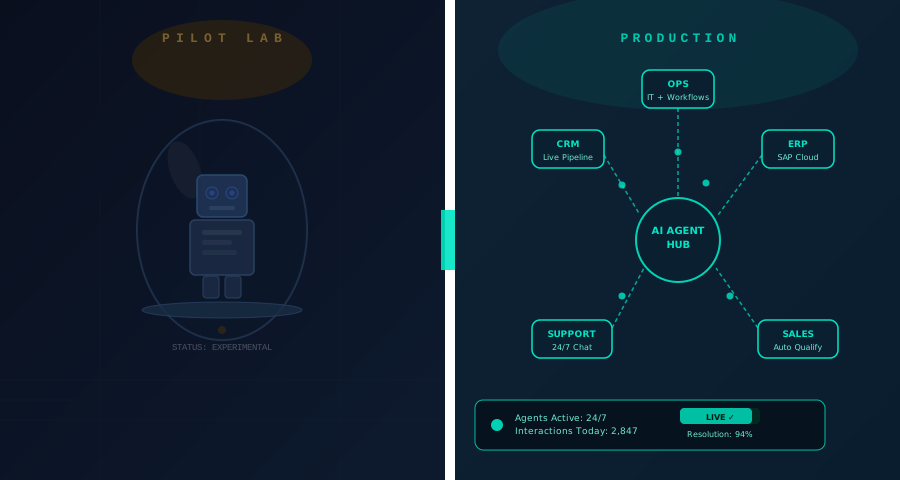
There used to be a polite fiction in enterprise technology: that the biggest companies in the world were "exploring" AI agents. Testing them. Running pilots.
That fiction just ended.
Last week, Parloa — a Berlin-based AI agent management platform valued at $3 billion — announced a sweeping set of enterprise partnerships with SAP, Microsoft, OpenAI, Five9, and Epic. SAP is not just partnering with Parloa; SAP is using Parloa AI agents internally across their global workforce for IT support, and embedding the technology into SAP Service Cloud so enterprise customers can deploy AI agents with full access to live business data. Microsoft's CEO gave Parloa a keynote spotlight in Munich. OpenAI publicly showcased Parloa as a premier enterprise AI implementation. (Source: The Next Web, May 30, 2026 — https://thenextweb.com/news/parloa-turns-its-350-million-war-chest-into-a-partnership-web-spanning-sap-microsoft-and-openai/)
This isn't experimentation. This is infrastructure.
The number that should catch every business owner's attention
Parloa crossed $50 million in annual recurring revenue in the last year — and reported 150% net revenue retention, which means existing customers are dramatically expanding their usage, not just renewing. Meanwhile, MIT Sloan and Boston Consulting Group research shows enterprise adoption of agentic AI has soared 44% since 2023, and Deloitte predicts three-quarters of global companies will be operating AI agents by 2028.
That's not a trend line — it's a countdown. The window where AI agents give early movers a meaningful competitive advantage is closing faster than most business owners realize.
What 'production-ready' actually means for business owners
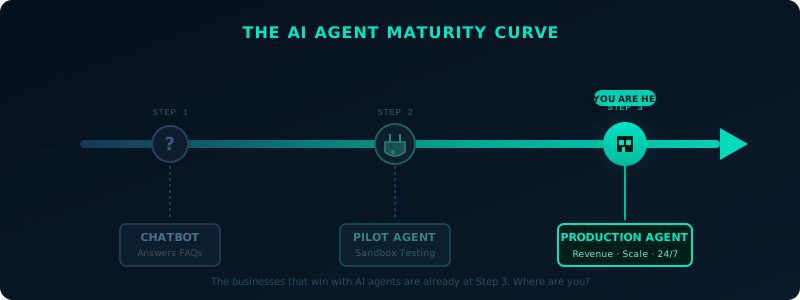
Here's the distinction that matters for founders and operators: a pilot AI agent is one your IT team demos in a sandbox. A production AI agent is one that touches real customers, real sales pipelines, and real revenue — every single day, at scale, without constant hand-holding.
The Parloa news is significant precisely because these partnerships are designed to solve the hardest part of deploying agents at scale: making them work inside your existing systems. The integrations aren't with toy environments — they're with SAP Service Cloud, Microsoft Azure, and Epic (the healthcare records system hospitals depend on).
When SAP bakes an AI agent layer into their service platform, the thousands of businesses running SAP inherit the ability to deploy agents that can resolve tickets, not just log them. That's the shift. Agents that don't just answer — agents that act.
Three business functions where this plays out right now
- Customer Support That Never Clocks Out: Agents handle inbound inquiries, returns, billing questions, and appointment bookings across voice, chat, and digital channels simultaneously — pulling live CRM data and resolving issues without a human in the loop. For a support team of five, a well-deployed agent is the equivalent of hiring five more who work 24/7 at a fraction of the cost.
- Internal Operations and IT Support: SAP's own deployment is instructive — they're using Parloa agents to handle internal IT support globally. Password resets, system access requests, expense submissions, onboarding tasks. These structured, repeatable workflows are exactly what agents handle better and faster than any human ticket queue.
- Sales Qualification and Pipeline Automation: The same agent infrastructure — live CRM access, voice capability, real-time data lookups — applies directly to sales. Agents that qualify leads, schedule demos, follow up on dormant pipeline, and log notes to Salesforce without a rep lifting a finger are a force multiplier, not a gimmick.
The hidden lesson: guardrails make agents actually useful
Parloa's partnership with Epic enables HIPAA-compliant AI agents for healthcare — and that detail is not a footnote. It's a signal that governance and compliance are now core features of production agent deployments, not afterthoughts.
The businesses that win with AI agents aren't the ones who deploy fastest and hope for the best. They're the ones who design clear boundaries up front: which data the agent can access, which actions it can take autonomously, when it escalates to a human, and how every interaction is logged.
Before you deploy, answer these three questions:
- What specific workflow does this agent own end-to-end? (Not 'help with customer stuff' — get precise.)
- Where does it hand off to a human, and how? (Define the escalation trigger before launch.)
- How do you measure whether it's performing? (Resolution rate, handle time, CSAT — pick your metrics up front.)
What this means if you haven't started yet
If you're still treating AI agents as something to 'explore next quarter,' the market is moving without you. SAP, Microsoft, and OpenAI are not aligning with a $3 billion AI agent company because agents are interesting in theory. They're aligning because agentic AI is already generating revenue, retaining customers, and reducing operational costs at scale.
The businesses that benefit most won't be the ones who wait for the technology to mature further — it already has. They'll be the ones who identify a high-value, well-defined workflow, deploy an agent to own it, and use the time and cost savings to go after the next one.
“The compounding advantage of AI agents doesn't come from deploying the most. It comes from deploying first, learning fast, and building on what works. And it starts with one workflow.”
— TGAND Technologies
At TGAND Technologies, we help business owners and operators move from AI curiosity to AI implementation — identifying the workflows worth automating, choosing the right tools, and building agent systems that actually perform. Ready to move from pilot to production? Visit tgandtech.com to get started.
Like what you're reading?
Get one practical outbound tip in your inbox every week.