The AI Agent Cost Trap: Why “Autonomous” Workflows Need a CFO Button
A new TechTarget article on FinOps for agentic AI highlights a critical business lesson: AI agents can create leverage, but only when cost, value, and guardrails are designed into the workflow.
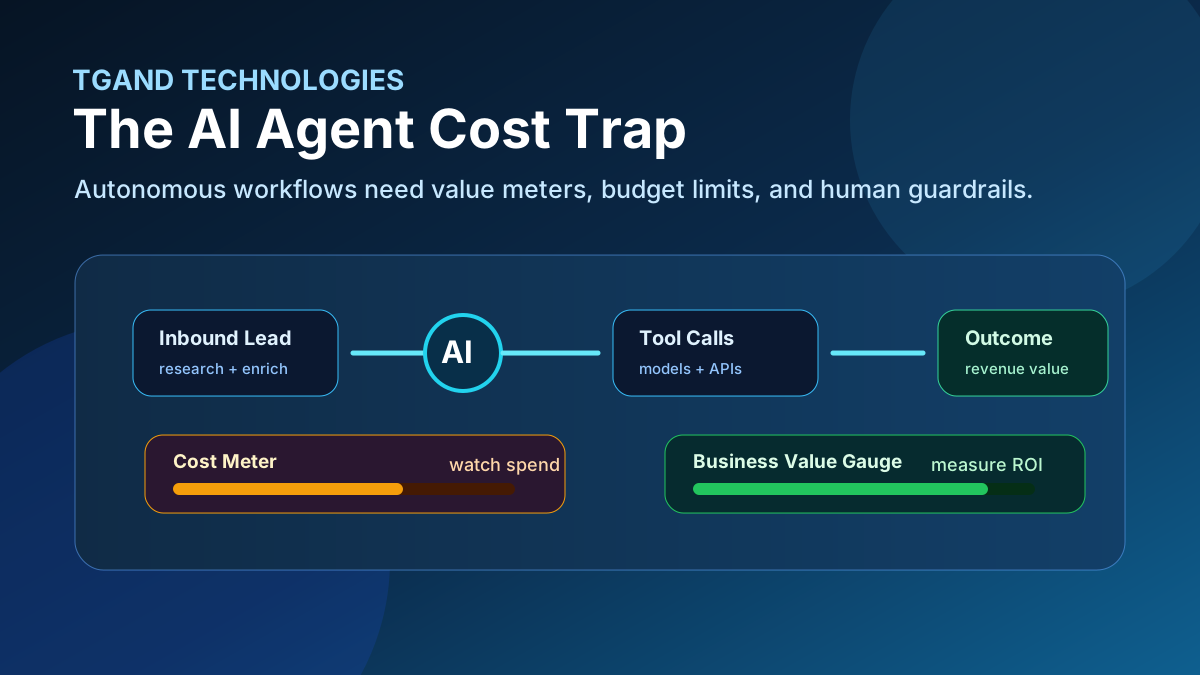
TechTarget reported on May 29, 2026 that businesses need FinOps-style visibility for agentic AI costs as autonomous workflows begin chaining together model calls, tools, retries, and data access. Source: TechTarget, “How to apply FinOps to optimize agentic AI costs” — https://www.techtarget.com/searchenterpriseai/tip/How-to-apply-FinOps-to-optimize-agentic-AI-costs
AI agents are being sold as the next major productivity unlock: digital teammates that can research, reason, trigger tools, update systems, and keep work moving without waiting for a human at every step.
That promise is real. But a new TechTarget article on applying FinOps to agentic AI points to a less glamorous issue every business leader should understand before scaling agents: autonomous work can also become autonomous spending.
When an AI agent handles a simple task, the cost may be tiny. When that agent breaks a job into dozens of steps, calls multiple models, searches files, queries databases, uses third-party tools, retries failed actions, and loops through follow-ups, the economics change fast.
For founders, revenue leaders, and operators, the lesson is not “avoid AI agents.” It is this:
The companies that win with agents will not be the ones that automate the most. They will be the ones that connect automation to measurable business value.
The hidden shift: from software seats to work units
Traditional SaaS spending is usually easy to understand. You pay per user, per seat, per month, or per usage tier. Agentic AI changes the model because the unit of value is no longer just access to software. It is work performed.
That work may include:
- reading an inbound lead;
- researching the company;
- enriching contact data;
- checking CRM history;
- drafting a personalized response;
- scheduling a follow-up;
- updating pipeline fields;
- alerting a sales rep;
- monitoring whether the prospect responds.
That is much more valuable than a chatbot answer. It is also a chain of actions, and every action can carry compute, API, data, or platform cost.
This is why agentic AI needs a different operating mindset. Businesses should not simply ask, “Can we automate this?” They should ask, “Is this workflow valuable enough to justify the agent’s cost when it runs hundreds or thousands of times?”
Where agents can pay for themselves
The strongest agent use cases tend to be tied to revenue, retention, or time-sensitive operations. If an agent reduces busywork but does not affect an important metric, it may still be useful — but it should not be the first place a business invests.
Better candidates include:
- Lead response agents that cut time-to-first-touch and prevent qualified prospects from going cold.
- Sales follow-up agents that monitor deal activity, draft next steps, and remind reps when accounts stall.
- Support triage agents that classify tickets, surface context, suggest replies, and escalate urgent issues faster.
- Operations agents that chase missing information, update internal systems, and prevent handoffs from disappearing in inboxes.
- Customer success agents that watch for churn signals and recommend proactive outreach.
These workflows have a clear business case because delays are expensive. A missed lead, an unresolved support issue, or a late renewal touchpoint can cost far more than the agent run itself.
The cost trap: agents that look productive but drift
Agent costs can become difficult to manage when teams treat autonomy as the goal.
An agent that writes one email is easy to budget. An agent that independently researches, rewrites, checks, retries, and escalates may be more useful — but it also needs limits. Without those limits, teams can end up with workflows that feel impressive in demos but are hard to justify in production.
Common failure patterns include:
- Over-researching simple tasks: using expensive reasoning steps when a template or rules-based decision would work.
- Looping behavior: retrying or rechecking without a clear stop condition.
- Too much autonomy too soon: allowing agents to take costly actions before the workflow has been measured.
- No cost-per-outcome tracking: measuring activity instead of business results.
- Poor data hygiene: forcing agents to spend extra time resolving messy, fragmented, or missing information.
This is where FinOps thinking becomes practical for non-technical leaders. The point is not to turn every founder into a cloud accountant. The point is to make sure agent workflows have visibility, accountability, and value measurement from the beginning.
A simple framework for business leaders
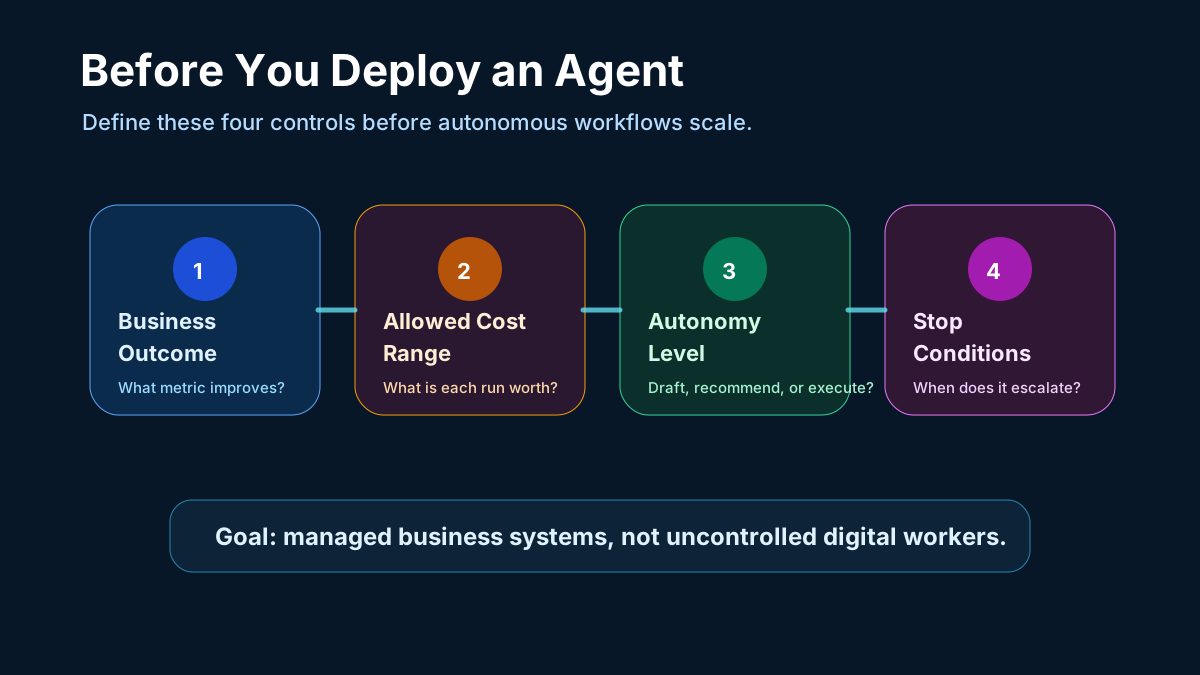
Before deploying an AI agent, define four things:
1. The business outcome — What should improve? Faster lead response, fewer missed follow-ups, lower support backlog, shorter quote turnaround, better renewal coverage, cleaner CRM data?
2. The allowed cost range — What is the workflow worth per completed action? A $3 agent run may be excellent for a high-intent sales opportunity and wasteful for a low-value admin task.
3. The autonomy level — Should the agent draft, recommend, update, or execute? High-impact actions — pricing, refunds, contract changes, customer commitments — should usually start with human approval.
4. The stop conditions — When should the agent stop trying and escalate? Missing data, low confidence, repeated failure, unusual customer requests, or anything outside policy should route to a person.
This turns AI agents from “cool automation” into managed business systems.
Practical guardrails that keep agents valuable
If your team is exploring agents, build the guardrails before scale:
- Track cost per workflow, not just total AI spend. Know what it costs to qualify a lead, triage a ticket, or complete a follow-up sequence.
- Use cheaper steps where possible. Not every task needs the most powerful model. Classification, routing, and formatting can often use lighter approaches.
- Require human review for expensive or sensitive decisions. Autonomy should increase only after performance is proven.
- Log every action. Leaders should be able to see what the agent did, what data it used, and why it escalated or acted.
- Measure outcomes. Tie agent activity to response time, conversion rate, customer satisfaction, backlog reduction, or hours saved.
The best agents are not uncontrolled digital workers. They are well-designed workflow accelerators.
The business lesson
The next wave of AI adoption will separate companies that experiment from companies that operationalize.
Experimenting with agents is easy. Scaling them profitably is harder. It requires the same discipline leaders already apply to hiring, software spend, sales operations, and customer experience: define the job, measure the output, manage the cost, and improve the process.
That is why the TechTarget piece is timely. As agentic AI moves from pilots into real business operations, cost management cannot be an afterthought. It has to be part of the design.
At TGAND Technologies, we help businesses build practical AI workflows that are useful, measurable, and safe to operate. If your team is considering AI agents for sales, support, operations, or internal follow-up, the right starting point is not maximum autonomy. It is one valuable workflow with clear guardrails and a measurable return.
Like what you're reading?
Get one practical outbound tip in your inbox every week.