Agentic AI Is Coming for the Hidden Bottlenecks in Your Business
A new Forbes piece on agentic AI in factories points to a bigger business lesson: AI agents create leverage when they attack slow handoffs, quotes, approvals, and follow-up.
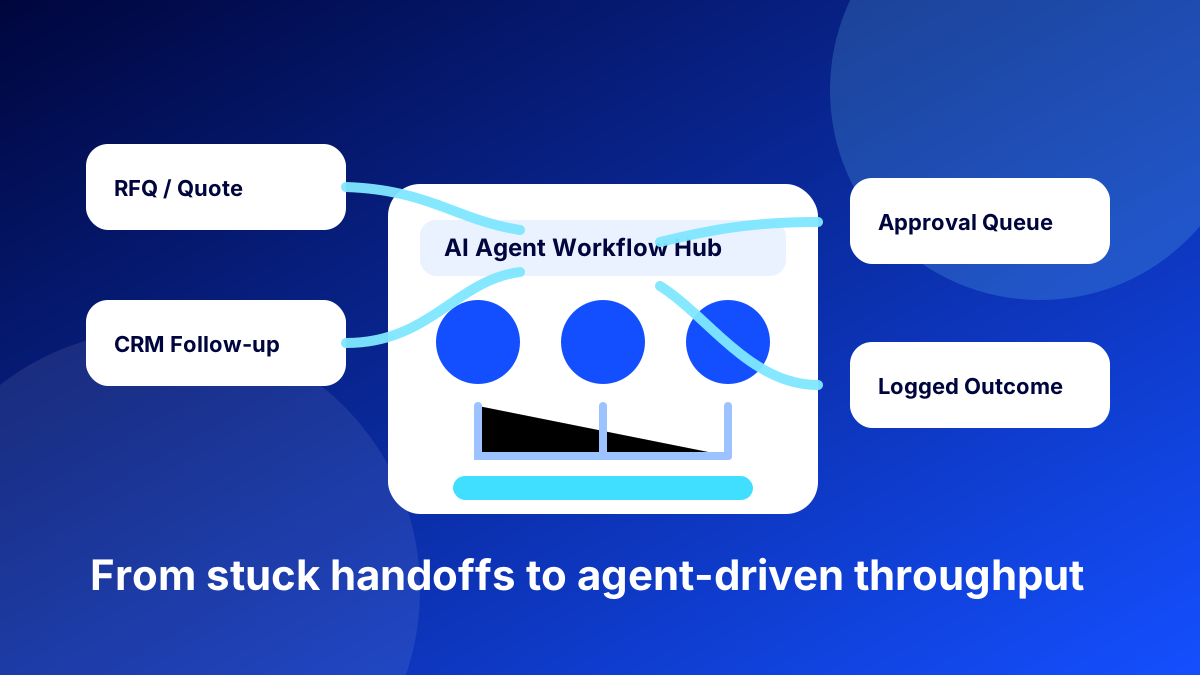
Forbes reported on May 28, 2026 that agentic AI is beginning to reshape factory workflows, including one of manufacturing's least glamorous but most expensive bottlenecks: quoting. Source: Forbes, “The Next Just-In-Time? How Agentic AI Is Rewiring The Factory” — https://www.forbes.com/sites/michaelashley/2026/05/28/the-next-just-in-time-how-agentic-ai-is-rewiring-the-factory/
Factories are not usually where business leaders look for their next software advantage. But a fresh Forbes article makes a sharp point: agentic AI may be starting with one of the least glamorous, most expensive bottlenecks in manufacturing — quoting.
That should get every founder, revenue leader, and operator’s attention.
The article frames agentic AI as a potential “next Just-In-Time” moment for factories, with AI agents helping teams move faster through work that is repetitive, detail-heavy, and full of handoffs. The specific example is the quoting bottleneck: a prospect sends an RFQ, humans pull specs together, teams check capacity and pricing, someone builds a response, and the deal waits.
But the bigger lesson is not about factories. It is about every business process where revenue gets delayed because the next step depends on a person finding context, making a routine judgment, and pushing work forward.
The real agent opportunity: bottleneck removal
Most companies are still thinking about AI in terms of content generation: write an email, summarize a meeting, draft a proposal. Useful, but limited.
AI agents change the frame. Instead of asking, “What can AI write?” the better question is: Where does work stall because someone has to gather information, decide the next action, and execute a repeatable workflow?
That is where agents can create leverage.
In a manufacturing quote workflow, an agent might help:
- read an inbound RFQ and extract requirements;
- compare the request against past jobs, materials, and pricing rules;
- flag missing details before a human wastes time reviewing it;
- draft a quote package;
- route edge cases to the right expert;
- follow up automatically if the buyer goes quiet.
Now translate that pattern outside the factory.
A sales team has the same problem when inbound leads sit untouched. A support team has it when complex tickets bounce between departments. An operations team has it when approvals, vendor requests, invoices, or onboarding tasks pile up in inboxes. The surface area changes, but the bottleneck is the same: context collection plus next-step execution.
Why this matters for smaller and mid-sized businesses
Large enterprises are already testing agentic workflows because small process improvements compound at scale. But smaller businesses may have the more urgent opportunity.
A ten-person company does not have extra staff sitting around to chase every lead, clean every CRM field, or monitor every open customer issue. When work stalls, it often stalls quietly. A quote is late. A follow-up never happens. A customer waits too long. A founder becomes the routing system for everything.
That is exactly where a well-scoped AI agent can act like operational leverage.
Not a replacement for the team. Not an unsupervised robot making strategic decisions. A focused digital teammate that watches a workflow, gathers context, drafts the next action, and keeps the process moving.
Practical examples worth exploring now
For business owners evaluating AI agents, the best starting point is rarely “build one agent to run the company.” It is one high-friction workflow with measurable value.
Good candidates include:
- Lead response agent — qualifies inbound requests, enriches company/contact data, drafts the first response, and alerts a human when a lead is high intent.
- Quote or proposal agent — pulls prior pricing, relevant case studies, standard terms, and customer requirements into a human-ready draft.
- Support triage agent — categorizes tickets, identifies urgency, suggests replies, and escalates issues with the right context attached.
- Ops follow-up agent — monitors open tasks across email, CRM, project boards, or forms and nudges the right person before deadlines slip.
- Customer success agent — watches usage signals or account activity and suggests proactive check-ins before churn risk becomes obvious.
Each of these has something in common: the agent is not “doing AI” for its own sake. It is compressing the time between request and response.
The guardrails matter as much as the automation
The Forbes manufacturing example is compelling because quoting is valuable, but it is also sensitive. Price, capacity, delivery timelines, and contract terms affect margins and customer trust.
That is a useful reminder: agentic AI works best when autonomy is earned in stages.
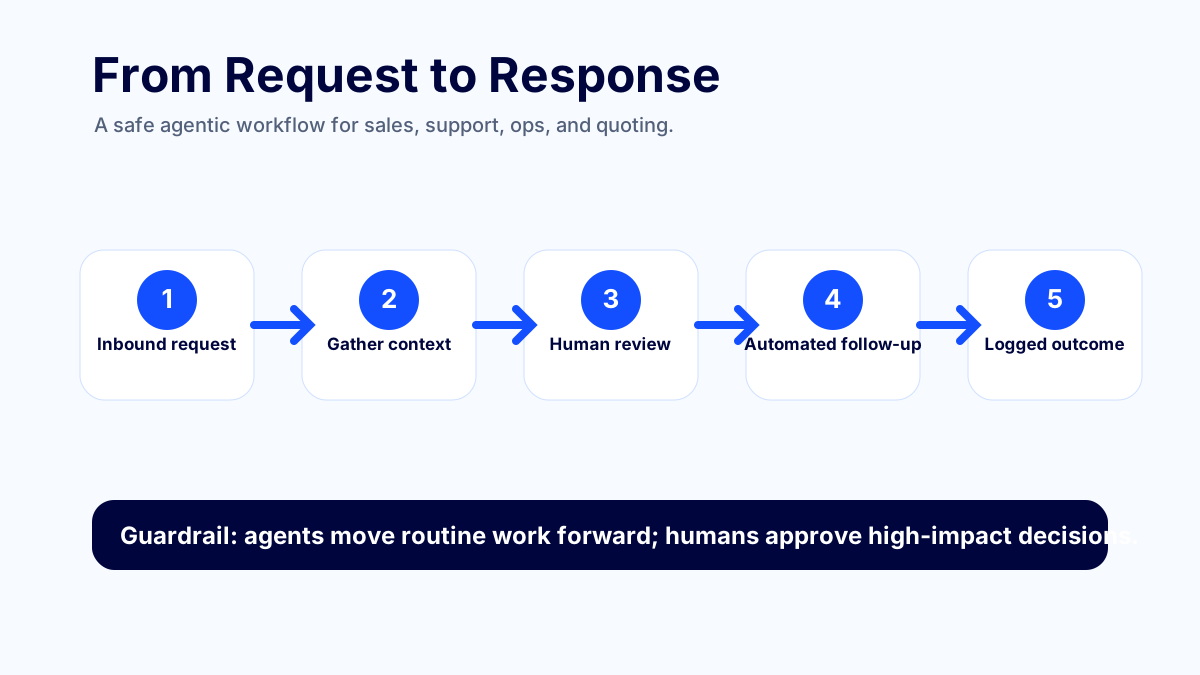
A practical rollout should include:
- Clear boundaries: define what the agent can draft, recommend, update, or send.
- Human approval for high-impact actions: quotes, refunds, contract changes, and customer commitments should start with review.
- Source visibility: the agent should show what data it used and why it made a recommendation.
- Audit trails: every automated step should be logged.
- Fallback paths: when confidence is low or data is missing, the agent should escalate instead of guessing.
The goal is not maximum autonomy on day one. The goal is dependable throughput: fewer dropped balls, faster response times, and better use of human judgment.
The business lesson
Agentic AI is becoming less of a future concept and more of a process design question.
The winners will not be the companies that add “AI” to every tool. They will be the companies that identify their slowest revenue and operations handoffs, then build agents around those constraints.
If your team is asking where to start, look for the work that is:
- repetitive but not trivial;
- dependent on information spread across systems;
- time-sensitive;
- easy to review after an agent drafts the next step;
- tied to revenue, retention, or customer experience.
That is where AI agents can move from novelty to measurable business value.
At TGAND Technologies, we help businesses turn these bottlenecks into practical AI workflows — from lead handling and support triage to internal operations and agent-assisted follow-up. If your team knows there are places where work is moving too slowly, that may be the best place to start.
Like what you're reading?
Get one practical outbound tip in your inbox every week.