Salesforce Just Paid $3.6 Billion for a Support Agent That Answers 76% of Tickets — Are You Ready?
Salesforce's $3.6B acquisition of Fin — formerly Intercom — reveals a hard truth: AI support agents that handle three-quarters of customer queries aren't a future experiment. They're here. Here's what it means for your business right now.
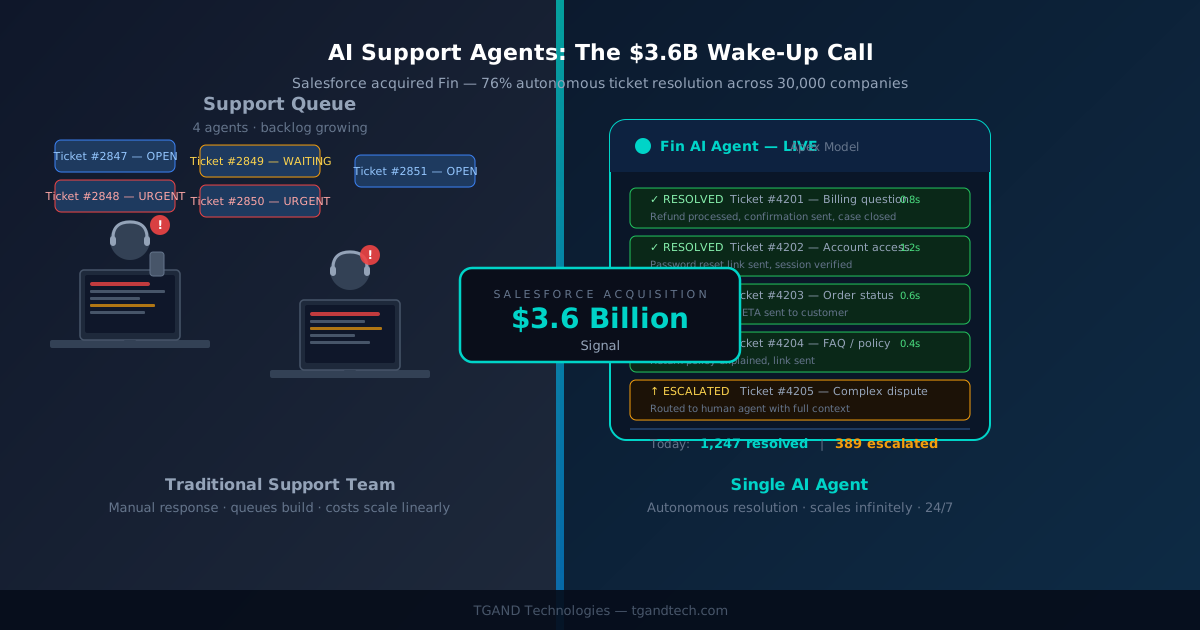
When a company the size of Salesforce writes a $3.6 billion check for a single capability, the market is sending you a memo.
Last week, Salesforce announced it is acquiring Fin (formerly known as Intercom) for approximately $3.6 billion. The deal adds Fin's AI customer service agent — powered by a proprietary model called Apex — directly into Salesforce's Agentforce platform. The headline number that stopped every operator in their tracks: Fin's AI agent resolves 76% of customer support queries end-to-end, without a human ever touching the ticket. Source: TechRadar, "Salesforce snaps up customer service software giant Fin for $3.6bn" — https://www.techradar.com/pro/salesforce-snaps-up-customer-service-software-giant-fin-for-usd3-6bn
Three-quarters. Autonomously. Across 30,000 companies already live on the platform.
If you run a business with a support queue, sales inbox, or operations team, that number deserves your full attention.
The Signal Behind the Acquisition
This isn't Salesforce bolting on a chatbot. Fin was already a mature, production-proven AI agent before the deal — the kind that replaces your Tier 1 support layer entirely, not just augments it. The acquisition is Salesforce saying, loudly, that the era of human-staffed first-response is effectively over for most routine queries.
Salesforce's Agentforce suite already handles sales, ops, and marketing automation. Adding Fin's customer support agent means a single platform can now run autonomous agents across nearly every customer-facing function: pre-sale, post-sale, and everything in between.
The implication for smaller and mid-market businesses is sharper than it sounds: the biggest player in enterprise software just validated that AI agents in customer service aren't a pilot program — they're the product.
What a 76% Resolution Rate Actually Means for Your Business
Let's make this concrete. Imagine your support team handles 1,000 tickets a month. Under a Fin-level AI agent:
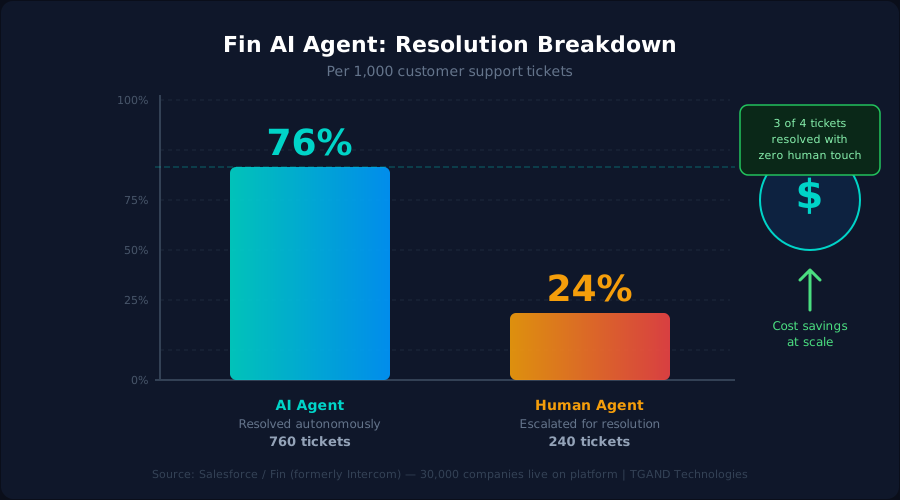
- 760 tickets are resolved without any human involvement — billing questions, status checks, returns, FAQs, account changes.
- 240 tickets are escalated to a human agent — the genuinely complex, sensitive, or high-value conversations that actually benefit from empathy and judgment.
For a team of four support reps, that's effectively reclaiming three people's worth of time — not to fire anyone, but to redeploy them toward retention, upsell conversations, and edge cases that actually move revenue.
The math on cost is just as striking. If each support rep costs your business $50,000–$70,000 per year (salary, benefits, onboarding, management overhead), a well-implemented AI agent handling 76% of volume doesn't just reduce costs — it unlocks a fundamentally different operating model.
This Isn't Just a Salesforce Story
Salesforce is consolidating the high end of the market, but the underlying technology is available right now to businesses of any size. AI agent platforms designed for customer support, sales follow-up, and operations workflows exist across price points — from enterprise Agentforce down to nimble, API-first tools that a ten-person team can deploy in weeks.
The strategic risk isn't that you can't afford what Salesforce just bought. The risk is assuming this shift is still three years away. The 30,000 companies already running Fin-powered support weren't waiting for a $3.6B acquisition to validate them — they started iterating early and are now compounding the advantage.
A few patterns we're seeing in businesses that are ahead:
- Start with containment, not replacement. The first-win AI agent handles your top 10–15 ticket categories — not your entire queue. Prove ROI on a slice before scaling.
- Build human-handoff into the design from day one. The 24% of queries that need a human aren't a failure — they're where your team shines. Design the agent to recognize that boundary cleanly.
- Train on your real data. Generic chatbots fail because they're generic. AI agents trained on your actual product, policies, and customer language resolve issues faster and with less frustration.
- Measure resolution rate, not just deflection rate. Deflection just moves a query somewhere else. True resolution means the customer got their answer and moved on. That's the bar Fin built its reputation on.
The Broader Shift: AI Employees, Not Just AI Tools
What the Salesforce-Fin deal signals — along with a wave of similar enterprise moves — is a reframing that matters for every business owner: AI agents are increasingly treated as employees with defined roles, metrics, and accountability, not just software features.
Fin has a resolution rate. It has an escalation policy. It has performance benchmarks. It serves 30,000 companies the way a good hire serves one.
“You're not buying a tool — you're onboarding a team member with specific responsibilities. That means clear scope, clear KPIs, and a clear chain of escalation when something is outside its lane.”
— TGAND Technologies
Businesses that adopt this framing early tend to get dramatically better results than those still thinking about AI as a feature to turn on.
Where TGAND Fits In
At TGAND Technologies, we help businesses move from AI curiosity to AI operations — without needing a $3.6 billion acquisition budget or a dedicated AI engineering team to get there.
Whether you're looking to deploy your first customer support agent, automate a sales follow-up workflow, or map out which business functions are your highest-leverage AI opportunities, we can help you build a real system that runs — not just a demo. Visit tgandtech.com to get started.
Published by TGAND Technologies. Sources: TechRadar (June 16, 2026), CMSWire (June 15, 2026), SiliconANGLE (June 15, 2026).
Like what you're reading?
Get one practical outbound tip in your inbox every week.