Your AI Agent Just Got a Credit Card: What Mastercard's Agent Pay Means for Business Owners
Mastercard's Agent Pay for Machines lets AI agents make payments autonomously — no human clicks required. Here's what that shift means for your business operations, procurement, and risk guardrails.
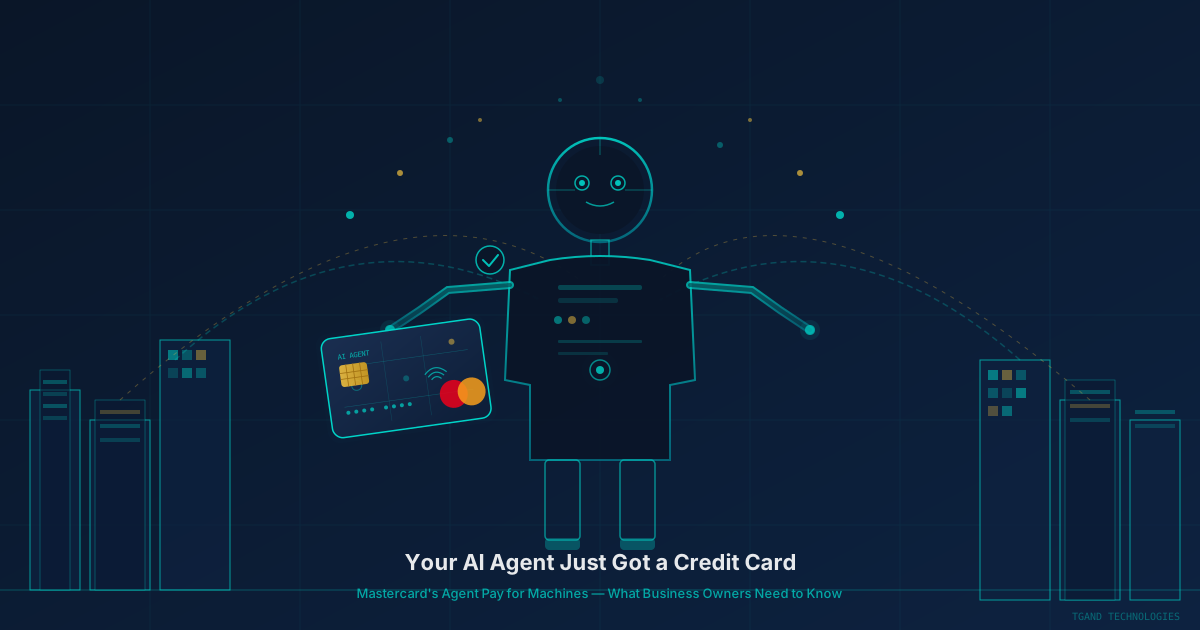
Source: C# Corner (Mahesh Chand) reported on June 10, 2026 on Mastercard's Agent Pay for Machines initiative — new payment infrastructure that gives AI agents trusted, programmable payment rails to make financial transactions autonomously. ("Mastercard's Agent Pay for Machines: How AI Agents Are Becoming Financial Actors" — https://www.c-sharpcorner.com/article/mastercards-agent-pay-for-machines-how-ai-agents-are-becoming-financial-actors/)
For the past two years, every AI conversation in the business world has been some version of the same story: AI answers questions, summarizes documents, drafts emails, and helps humans make better decisions.
Mastercard just changed that story.
This week, Mastercard announced Agent Pay for Machines — a new initiative that gives AI agents trusted, programmable payment rails to make financial transactions autonomously. No human clicks. No approval chains. No finance person manually processing a $12 API subscription at 2 AM.
The agent finds it. The agent decides. The agent pays.
If you're a business owner, founder, or operations leader, this is not a fintech headline to skim past. This is the clearest signal yet that we are moving from AI as an assistant to AI as an economic actor — and the implications for how you run your business are profound.
What Is Agent Pay, Exactly?
At its core, Mastercard's Agent Pay for Machines creates secure financial infrastructure specifically designed for AI agents. Think of it as giving your AI employees a corporate card with built-in guardrails.
The system is designed to handle what traditional payment infrastructure never could:
- High-frequency, low-value transactions — $0.20 API calls, $3 compute bursts, $8 SaaS add-ons that no human can practically review one by one
- Machine-speed decision-making — when an AI agent needs to spin up cloud resources at 3 AM to handle a traffic spike, waiting for a payment approval kills the value
- Verifiable agent identity — every agent gets a trusted digital identity (think: a digital passport), so the system knows who authorized the action and what it's allowed to spend
The initiative involves a broad partner ecosystem spanning traditional finance, crypto, and blockchain infrastructure — including organizations connected to Polygon, Ripple, Solana, Coinbase, and others — hinting that programmable digital assets may eventually underpin much of this machine-to-machine commerce.
What This Looks Like in Your Business
This isn't abstract. Here are four operational scenarios that become real once agents can transact:
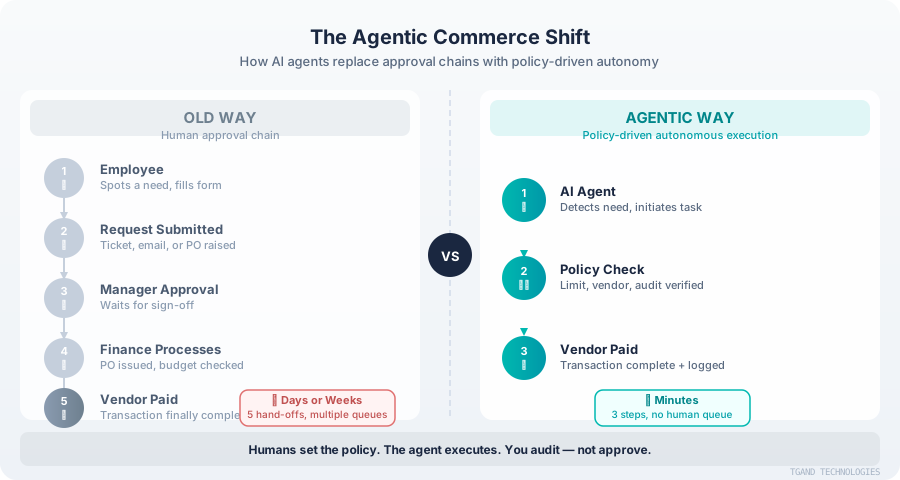
- AI-Driven Procurement: Your AI procurement agent monitors your vendor contracts, compares alternatives, identifies a SaaS tool that's 35% cheaper with equivalent functionality, migrates your workloads, cancels the old subscription, and updates the payment — all within defined spending limits. What used to take weeks of back-and-forth now happens in minutes.
- Autonomous Marketing Spend: An AI marketing agent purchases ad inventory in real time, shifts budget between channels based on live performance data, and switches vendors automatically when CPCs spike — without waiting for a weekly budget review meeting.
- Operations and Supply Chain: In healthcare or logistics, AI agents can order supplies automatically, pay verified vendors, and manage recurring operational subscriptions without a single human touching the approval chain for routine transactions.
- Software Development Infrastructure: An AI coding agent building your product can purchase additional cloud credits, subscribe to testing APIs, and pay for monitoring tools on-demand — staying unblocked while staying within the spending policies you set.
The Part Nobody Is Talking About: Guardrails
Here's where business owners need to think carefully.
Giving an AI agent the ability to transact creates genuinely new risks. Mastercard's announcement implicitly acknowledges this — the entire system is built around policy engines, identity layers, and audit trails, not unlimited autonomy.
The risks are real:
- Prompt injection attacks: A malicious vendor webpage could manipulate an AI agent into making unauthorized purchases
- Budget drift: An "optimization" agent that's too aggressive can over-provision resources at machine speed — expensive mistakes happen faster than humans can catch them
- Vendor spoofing: AI agents could be tricked into paying fraudulent services impersonating trusted vendors
- Compliance exposure: Industries like healthcare and finance have strict rules that autonomous payments must navigate
The smart framing isn't unrestricted autonomy — it's human-supervised autonomy. You set the rules (allowed vendors, transaction limits, approval thresholds), and the agent executes within them. You audit, not approve, every small transaction.
“Businesses that win with agentic commerce will be the ones that build governance before they deploy agents, not after they've had a painful incident.”
— TGAND Technologies
What It Means for Founders Right Now
You don't need to integrate Mastercard Agent Pay this week. But you do need to start thinking differently about how your operations are structured.
The businesses positioning themselves well for the next 18–24 months are doing three things:
- Mapping which workflows currently require human approval for transactions — these are the highest-value candidates for agentic automation
- Designing spending policies and vendor whitelists — so when agents can transact, you already have guardrails in place
- Building agents that produce audit trails by default — because autonomous action without explainability creates compliance liability
The transition from "AI that assists" to "AI that acts" is already happening. Mastercard just built the payment layer for it.
The Bottom Line
Mastercard's Agent Pay for Machines is an infrastructure announcement, but its implications are strategic. When AI agents can reliably make payments within defined guardrails, entire categories of human operational overhead disappear.
Procurement teams shrink. Finance approval queues shorten. Marketing optimization becomes continuous rather than cyclical. Operations run 24/7 without on-call humans for routine decisions.
The competitive moat won't be having AI agents — it'll be having agents that operate safely, within governance frameworks, at a speed humans can't match.
At TGAND Technologies, we help businesses architect and deploy AI agents that actually work in production — with the guardrails, identity, and audit layers your operations require. If you're thinking about where agents fit in your workflows, visit tgandtech.com to get started.
Like what you're reading?
Get one practical outbound tip in your inbox every week.